Marketing Effectiveness Lab
Helps a UK ecommerce team decide where next quarter's marketing budget actually drives incremental revenue — turning noisy multi-channel data into cautious, uncertainty-aware budget recommendations via marketing-mix modelling, a Bayesian posterior layer, lift-test calibration, and a constrained budget optimiser, with a Streamlit executive dashboard.
Key finding
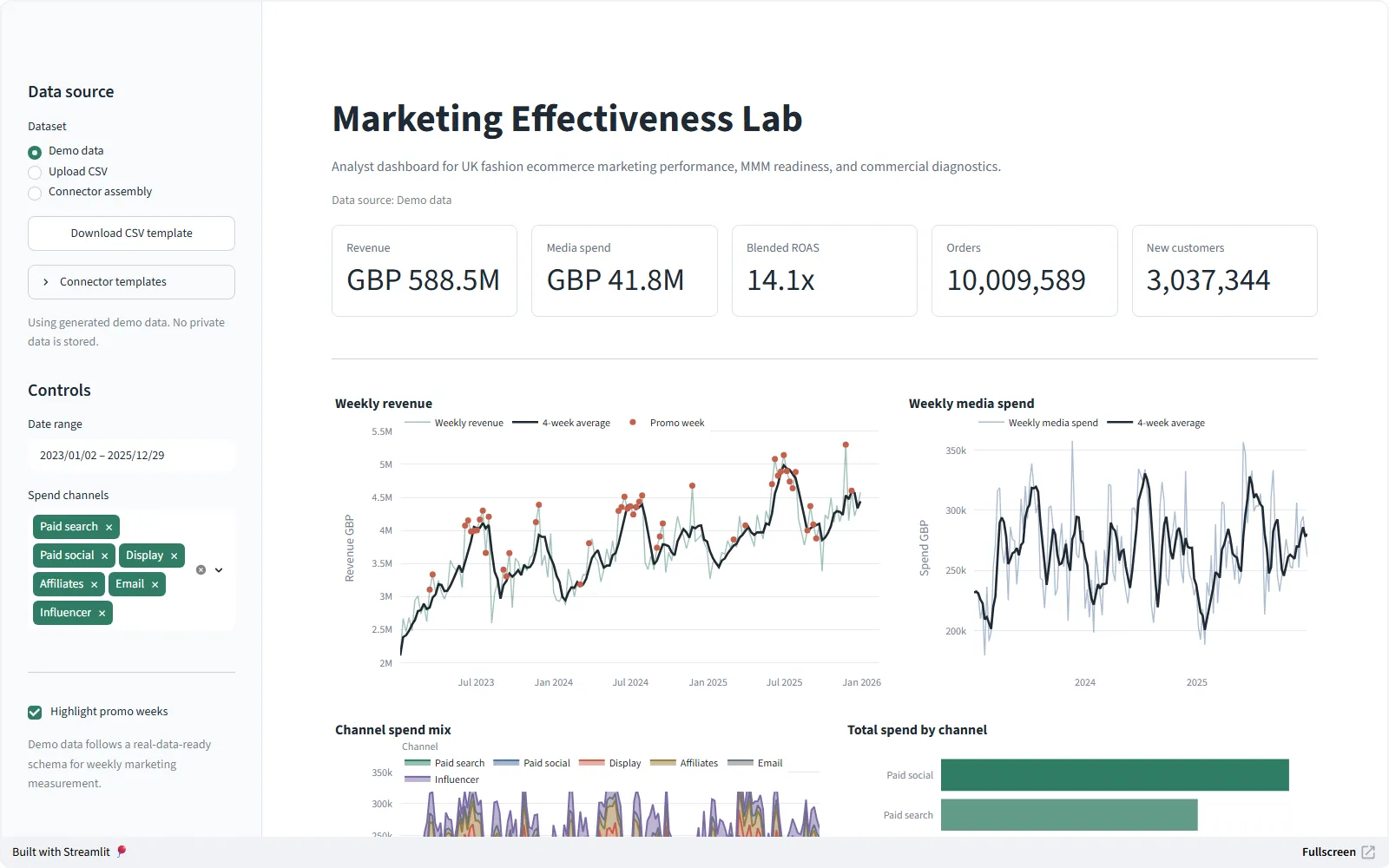
Status: archived. The standalone repo is archived and its methodology — MMM, incrementality calibration, and budget optimisation — now lives inside the Responsible Neobank Growth platform (
responsible-neobank-growth, which the Source button points to). The hosted dashboard is no longer publicly reachable — it answers into a sign-in redirect loop, and the repo’s own README says it “may sleep or require access and is not an always-on public demo”. The published report stays live, and is the honest link for an archived project.
Problem
A UK fashion ecommerce team wants to know which marketing channels actually drive incremental revenue — not just which channels happen to correlate with sales — and how to allocate next quarter’s budget under realistic constraints. That means turning noisy, multi-source marketing data into cautious, explainable investment recommendations that survive stakeholder scrutiny.
What I built
A portfolio marketing effectiveness platform that runs the full workflow a commercial or marketing data scientist is expected to own:
- Data contracts for weekly marketing, ecommerce, web analytics, paid media, CRM, affiliate, influencer, and external-control exports, with source diagnostics for coverage, missing channels, and modelling readiness.
- Marketing mix modelling (MMM) with adstock and saturation transforms, channel contribution, ROI, and response curves.
- A lightweight Bayesian posterior layer that reports uncertainty intervals instead of single-point ROI claims.
- Incrementality calibration: a lift-test evidence workflow that uploads experiment results, governs them, and folds them back in as experiment-informed priors.
- Budget optimisation: profit-aware scenario planning and constrained allocation, with an executive summary that carries the stakeholder caveats.
All data is synthetic. The platform is intentionally transparent about its assumptions rather than presented as a deployed production system.
Evaluation / evidence
- Time-aware holdout validation on the baseline econometrics, so model fit is judged out-of-sample rather than in-sample.
- Uncertainty intervals on contribution and ROI, so recommendations come with a confidence range.
- A recommendation-readiness scoring gate before any budget recommendation is presented for stakeholder review.
- A machine-readable model-run manifest for reproducibility and run-to-run comparison.
Scope
Business-facing modelling end to end: turning noisy marketing data into cautious, explainable budget-allocation recommendations, with the uncertainty and governance a real decision would demand.